
A Plain-Record Template for Logging Complaints and Resolutions
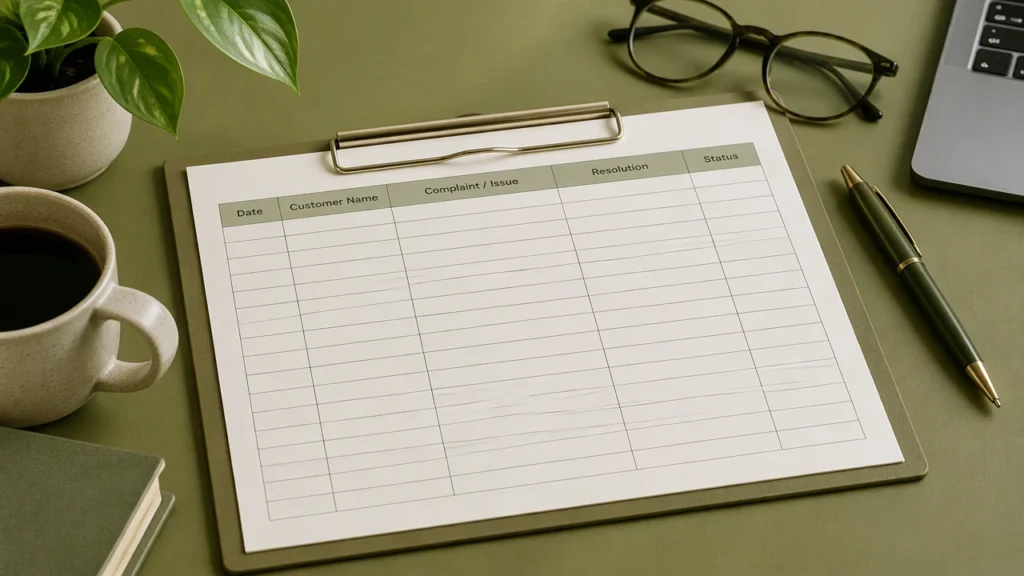
Good customer relationships rarely depend on a perfect system. They depend on remembering what happened, doing what you promised, and being able to explain the result later. A plain record of complaints gives you that memory without complicated software. This guide shows how to log client complaints and resolutions in a notebook using a template you can start today.
Why a plain record works
A complaint is easy to carry in your head for a day. It is much harder to recall three weeks later when the client calls back or a colleague takes over. Writing the details down turns a fleeting conversation into a stable record that can be reviewed, shared, and improved.
Plain records also keep attention on the work. You do not need fields you will never use or dashboards you will not open. You need the client’s words, the date, the action, the owner, and the outcome. Everything else is optional.
The basic complaint record
Use one page or one row per complaint. Keep the structure consistent so you can scan entries quickly. A useful record contains these parts:
- Date and time: When the complaint was received.
- Client and contact: Who raised it and how you reached them.
- Complaint in the client’s words: Write the issue plainly before you interpret it.
- Impact: What it affected, such as delivery, billing, access, or trust.
- Immediate response: What you said or did in the first contact.
- Action plan: The next steps, owner, and target date.
- Outcome: What changed and whether the client accepted it.
- Follow-up: The date you checked back and any final note.
Keep the original complaint separate from your analysis. The client’s wording shows what they experienced; your notes show what you understood. Mixing the two can hide misunderstandings until later.
A simple template you can copy
Start each entry with a short heading that identifies the case, then fill the fields in order. For example:
Complaint entry
Date received: 14 May, 10:20
Client: Northfield Studio
Channel: Phone
Client’s description: Invoice shows an extra charge for a service that was not requested.
Impact: Payment delayed; client concerned about hidden fees.
Immediate response: Apologised for confusion, confirmed we would review the invoice within one working day.
Action: Check contract scope and billing history; owner: Alex; due: 15 May.
Outcome: Duplicate line removed, corrected invoice sent, client confirmed payment on 16 May.
Follow-up: Sent a short confirmation email and noted a billing check for future orders.
You can write this on paper, in a spreadsheet, or in a document. The format matters less than keeping every entry in the same order.
How to capture the complaint accurately
When a complaint arrives, listen before you solve. Ask the client to describe the problem in their own words, then repeat it back in a sentence or two. Write down the facts that can be checked: dates, order numbers, amounts, and what the client expected.
Avoid turning the entry into an argument. Record what was said, not what you believe the client meant. If you need to add context, label it clearly as your note. This makes the record fair and easier to use in a later review.
Log the action, not just the intention
A plan is useful only when it has an owner and a date. Write the next action as something a person can complete: “Send corrected quote,” “Call supplier,” or “Confirm access has been restored.” Vague notes such as “look into it” create follow-up work and leave the client waiting.
Update the same entry as the case moves. Add a line each time something changes, with the date and the person who acted. You should be able to see the sequence without reading a long narrative.
Record outcomes and close the loop
An outcome is more than “fixed.” State what the client received, what changed internally, and whether the client agreed that the issue was resolved. If the client remains unhappy, note the remaining concern and the next review date instead of forcing a closed status.
Close the loop with a short confirmation. It can be an email, a message, or a note in the record. The purpose is to make the result visible to both sides and to prevent the same complaint from returning unnoticed.
Review patterns, not isolated stories
Set a regular time, perhaps once a week, to read recent entries. Look for repeated themes: delayed deliveries, unclear invoices, missed callbacks, or confusing instructions. Counting similar complaints is often enough to show where a process needs attention.
Use the review to improve the service, not to assign blame. Choose one small change, record it as an action, and check whether the pattern declines. Over time, the log becomes a practical guide to prevention.
Keeping records safe and useful
Decide who can read the notebook or file and where it is stored. Keep personal details to what you need for the case, and follow your organisation’s privacy rules. If the record is shared, use clear names and dates so another person can pick it up without a long explanation.
Simple habits make the system last: write entries the same day, use consistent headings, and review old cases before they become forgotten. A plain record will not solve every difficult conversation, but it will give your team a reliable place to start, a clear view of what was promised, and evidence of the outcome.